

All about Fenugreek – Rich History, Versatile Uses, and Remarkable Health Advantages

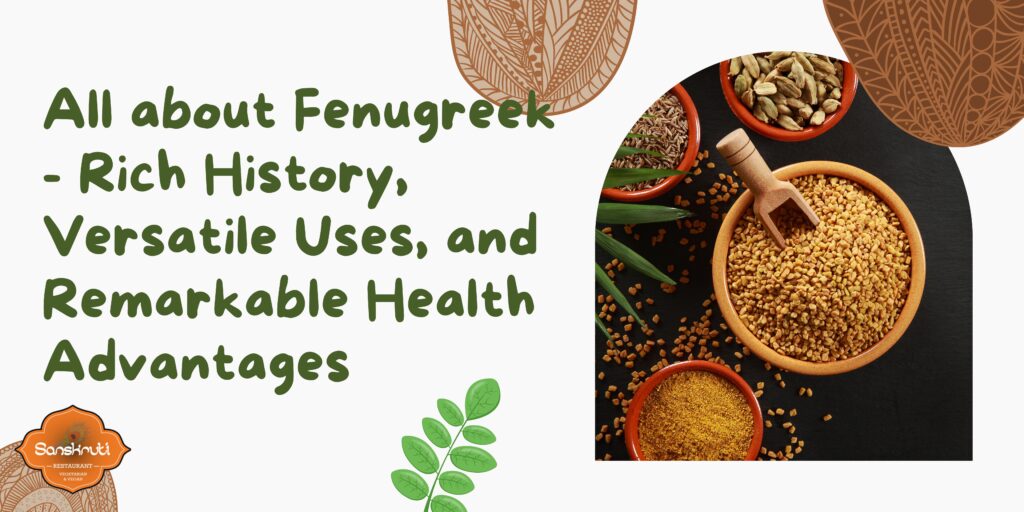
Fenugreek is a herb with a distinctive flavour profile with multipurpose medicinal properties. It is one of the most common ingredients used in Middle Eastern and Indian cuisines. In the article below, you will find more about Fenugreek: Ancient Origins and Modern Health Benefits.
What is Fenugreek?
Fenugreek is a perennial plant with small green leaves, white flowers and pods with tiny seeds. Scientifically it is called Trigonella foenum – graecum and belongs to the family Fabaceae. It has been used in Indian cooking for centuries not only for the lovely flavour it imparts to the dish but for its medicinal properties.
Every part of the fenugreek plant is nutrient dense and has potential health benefits. Due to the high nutritional profile, the seeds and leaves are both used in cuisines across the world.
Fenugreek seeds are small, yellowish brown hard seeds with smooth texture and oblong shape. Since ancient times, these tiny seeds have been used as a remedy for various medical conditions.
Origin
Fenugreek is native plant cultivated in parts of Asia, Northern Africa, Southern Europe and the Mediterranean region. The use of this dates back a few centuries and was a notable medicinal drug in India, Iraq and China. Ancient Egyptians used its extract in the mummification process.
India is the largest producer of fenugreek followed by Nepal, Bangladesh, Argentina, Egypt and Mediterranean countries – Lebanon and Morocco. In India it is extensively grown in Rajasthan, Gujarat, Madhya Pradesh, Uttar Pradesh, Maharashtra and Punjab.
Cooking with fenugreek
Fresh tender Methi (Fenugreek) leaves are used as a regular leafy vegetable in curries, stir fries and flavoured rice dishes.
Dried fenugreek leaves, generally referred to as kasoori methi in Indian cuisine is widely used to flavour the dishes specifically in North India. These dried leaves act as an excellent flavouring agent when crushed and added to curries, sauces and stir fries at the end just before turning the heat off.
Fenugreek seeds can be used whole or ground and are one of the most essential spices of Indian cuisine. To make spice blends or dry rubs these seeds are toasted along with other aromatic spices to intensify the flavour and reduce the bitterness before grinding to a powder.
How are fenugreek seeds used in Indian cooking?
Despite being bitter the fenugreek seeds are an indispensable element in many Indian spice blends such as Andhra cuisine’s special pulihora powder, sambar masala, garam masala and bisibele bath powder.
It is the most essential ingredient in making idli and dosa batter that helps speed up the fermentation process and make idli fluffy and soft.
These seeds are essential in pickles recipes. The main purpose of using them in pickles is for its distinctive flavour and aroma, to act as a preservative and as a coolant to reduce the heat from the pickle, and (remove) prevent heartburn and ulcers that could be caused due to extreme heat and spiciness of the pickles.
Health benefits of fenugreek
Fresh fenugreek leaves help control cholesterol and gastric disorders.
Both fenugreek seeds and leaves help boost milk production in lactating mothers.
The antioxidant, anti-fungal and anti-inflammatory properties of the fenugreek seeds is an excellent home remedy to treat hair loss and dandruff issues. The face mask made with fenugreek seeds paste helps get rid of dark spots and even out complexion.
What does fenugreek taste like?
Fenugreek seeds are incredibly bitter when eaten raw. By toasting these seeds, the bitterness diminishes slightly but we can’t get rid of it completely. However, it adds a depth of flavour when toasted along with the other ingredients and imparts a nutty taste to the dishes and has a maple syrup like flavour with a slight sweet note.
Unlike coriander, peppercorn and cumin, these are not just crunchy, rather extremely hard. Soaking overnight helps to soften these seeds.
Fresh fenugreek leaves have earthy and slightly bitter flavours. Dried leaves have a strong aroma with bitter sweetness that enhances the dishes.
Are fenugreek seeds good for health?
Yes, fenugreek seeds and powder have been used as a medicine in Ayurveda since ancient times due to its multiple benefits. Perhaps these powerful seeds have not only been used as a spice to flavour the food but as an ingredient that can help manage a healthy life. They are well-known as a home remedy to control diabetes. Consuming these tiny seeds regularly helps lower blood sugar levels and efficiently aids in other minor health issues such as cholesterol, inflammation, constipation and anaemia. Drinking the soaked fenugreek seeds water controls appetite and aids in weight loss. A small spoon of methi seeds swallowed along with a glass of water is a simple home remedy for diarrhoea.
List of popular Indian dishes with fenugreek-
- Methi Chaman: A delicious dish from Kashmiri cuisine made from fresh fenugreek leaves.
- Methi Mathri: One of the most popular crispy and crunchy savoury tea time snacks.
- Methi Malai Paneer: One of the most popular paneer dishes in the restaurant menu. Check the recipe at Flavours Treat.
- Methi Thepla: Spiced flatbread made with flour, fenugreek leaves and spices.
- Methi Muthiya: A delicious dumpling made of fenugreek leaves, spices and flour. It makes a great tea time snack, an essential part of signature Gujarati dish undhiyu.